
The water cycle, also called the hydrological cycle, is the continuous movement of water across the Earth’s surface, atmosphere, and underground reservoirs. It involves key processes like evaporation, condensation, precipitation, and runoff, which naturally recycle water from rivers, oceans, and lakes back into the environment. In daily life, the water cycle influences everything around us, from rainfall patterns affecting agriculture to humidity levels in homes and workplaces.
Understanding its synonyms, such as hydrologic cycle, water circulation, or hydrologic process, helps us recognize discussions in education, climate studies, or casual weather conversations. Knowing these terms is crucial for environmental awareness, effective communication, and scientific clarity. Awareness of alternative phrases allows you to explain water movement confidently and accurately.
In this guide, you will discover 35 precise synonyms and alternative terms for the water cycle, each with meaning, explanation, context, and real-life examples, helping you describe and use these terms naturally in conversations, writing, or learning materials.
What Does Synonyms of Water Cycle Mean?
The synonyms of water cycle refer to alternative terms or phrases that describe the continuous movement of water through Earth’s atmosphere, surface, and underground systems. Common equivalents include hydrological cycle, water circulation, and aquatic cycle. Understanding these synonyms is crucial in environmental science, meteorology, and education, where precise terminology affects clarity.
In real-life contexts, these terms appear in scientific reports, textbooks, and climate discussions. For instance, a hydrologist may describe water circulation when studying river systems, while educators often teach the water cycle to illustrate evaporation, condensation, and precipitation processes. Cognitively, using varied terms can enhance comprehension by providing semantic diversity, helping learners grasp complex processes from multiple perspectives. Moreover, culturally, some regions may favor specific terms, such as “aquatic cycle” in ecological studies, reflecting disciplinary nuances rather than casual speech.
Origins and Background of Synonyms of Water Cycle
The concept of the water cycle dates back to ancient civilizations that observed rainfall, rivers, and springs. Early Greek philosophers like Anaximenes noted the cyclical nature of water, while medieval scholars expanded these observations through hydrology and natural philosophy.
| Year / Era | Milestone / Concept | Key Contributor / Context |
| 6th century BCE | Observations of rainfall & rivers | Greek philosophers |
| 17th century | Scientific understanding of evaporation | Pierre Perrault |
| 19th century | Term “hydrological cycle” introduced | Modern hydrology textbooks |
| 20th century | Broader synonyms like “water circulation” used | Environmental sciences |
Over time, terminology evolved, giving rise to synonyms like aquatic cycle and water circulation, reflecting academic, professional, and educational adaptation. These variations allow scholars, educators, and communicators to frame the same phenomenon according to context, whether discussing climate models, agriculture, or freshwater management.
List of 35 Synonyms for Water Cycle with Meaning & Examples
1. Hydrologic Cycle
Meaning: The natural circulation of water from the Earth’s surface to the atmosphere and back.
Explanation: A scientific term often used in textbooks and environmental studies.
Use When: Explaining water processes in a formal, academic, or scientific context.
Examples:
- Scientists study the hydrologic cycle to predict droughts and floods.
- The hydrologic cycle ensures rivers, lakes, and groundwater are continuously replenished.
2. Hydrological Cycle
Meaning: Another term for the water cycle, emphasizing water movement and storage.
Explanation: Focuses on the stages of water traveling through nature, including evaporation, condensation, and precipitation.
Use When: Discussing scientific reports, climate studies, or earth science lessons.
Examples:
- The hydrological cycle plays a crucial role in agriculture and ecosystem health.
- Understanding the hydrological cycle helps communities prepare for water shortages.
3. Water Circulation
Meaning: The movement of water through natural systems like rivers, oceans, and the atmosphere.
Explanation: A simpler, everyday term for water cycle processes, highlighting flow and distribution.
Use When: Talking casually about how water moves in nature or environmental systems.
Examples:
- Ocean currents strongly influence global water circulation.
- Seasonal rainfall changes affect water circulation in wetlands.
4. Aquatic Cycle
Meaning: The continuous movement of water within aquatic ecosystems.
Explanation: Emphasizes water transfer in lakes, rivers, and oceans.
Use When: Focusing on ecology, fish habitats, or marine studies.
Examples:
- The aquatic cycle supports fish populations in freshwater lakes.
- Researchers study the aquatic cycle to protect wetlands.
5. Water Flow Cycle
Meaning: The pattern of water movement through natural landscapes.
Explanation: Highlights streams, rivers, and precipitation paths.
Use When: Explaining river systems, irrigation, or flood management.
Examples:
- Farmers monitor the water flow cycle to plan irrigation.
- Heavy rains can disrupt the water flow cycle in urban areas.
Read More: Synonyms of Dopamine | 35 Best Alternatives & Examples
6. Earth’s Water Cycle
Meaning: The planet-wide system of water movement through the environment.
Explanation: Stresses global water processes including ocean evaporation and atmospheric moisture.
Use When: Teaching geography, climate science, or environmental awareness.
Examples:
- Climate change impacts Earth’s water cycle by altering rainfall patterns.
- Understanding Earth’s water cycle helps manage natural resources.
7. Hydrologic Process
Meaning: Specific steps or stages in the movement of water through nature.
Explanation: Breaks down evaporation, precipitation, and runoff scientifically.
Use When: Writing research papers or educational guides on water systems.
Examples:
- Students study the hydrologic process to learn how rivers form.
- Engineers consider the hydrologic process when designing dams.
8. Precipitation Cycle
Meaning: The sequence of water falling from the atmosphere as rain, snow, or hail.
Explanation: Focuses on rainfall patterns and storm cycles.
Use When: Discussing weather forecasts, flood risks, or climate reports.
Examples:
- The precipitation cycle affects crop growth in agricultural regions.
- Understanding the precipitation cycle is essential for urban planning.
9. Evaporation-Condensation Cycle
Meaning: The movement of water through evaporation and condensation stages.
Explanation: Highlights the transition of water between liquid and vapor forms.
Use When: Explaining scientific processes in classrooms or laboratories.
Examples:
- Teachers demonstrate the evaporation-condensation cycle with a glass experiment.
- The evaporation-condensation cycle drives cloud formation.
10. Precipitation-Runoff Cycle
Meaning: The process of water moving from precipitation to rivers, lakes, and oceans.
Explanation: Focuses on surface water flow after rainfall or snowmelt.
Use When: Discussing floods, river management, or water conservation.
Examples:
- Engineers monitor the precipitation-runoff cycle to prevent flooding.
- Urban planners study the precipitation-runoff cycle to design drainage systems.
Read More: Synonyms of Archaeology | 35 Best Alternatives & Usage Examples
11. Water Circulation System
Meaning: The organized movement of water through natural and man-made systems.
Explanation: Covers both rivers, lakes, and oceans as well as water supply networks.
Use When: Explaining hydrology or urban water management.
Examples:
- Cities rely on the water circulation system for clean drinking water.
- Environmentalists study the water circulation system to protect wetlands.
12. Aquatic Movement
Meaning: The flow of water within lakes, rivers, and oceans.
Explanation: Focuses on water movement in aquatic ecosystems.
Use When: Discussing fish habitats, marine life, or river ecology.
Examples:
- Scientists tracked aquatic movement to study salmon migration.
- The aquatic movement ensures nutrient distribution in freshwater ecosystems.
13. Moisture Cycle
Meaning: The process of water vapor moving through the atmosphere and back to Earth.
Explanation: Highlights humidity, cloud formation, and rainfall.
Use When: Talking about weather, climate, or plant irrigation.
Examples:
- Farmers track the moisture cycle to predict irrigation needs.
- The moisture cycle affects humidity levels in greenhouses.
14. Rainfall Cycle
Meaning: The sequence of rain forming, falling, and replenishing water sources.
Explanation: Focuses on precipitation as part of the water cycle.
Use When: Explaining agriculture, water supply, or weather patterns.
Examples:
- The rainfall cycle is critical for crop production.
- Understanding the rainfall cycle helps manage reservoir levels.
15. Climate Water Cycle
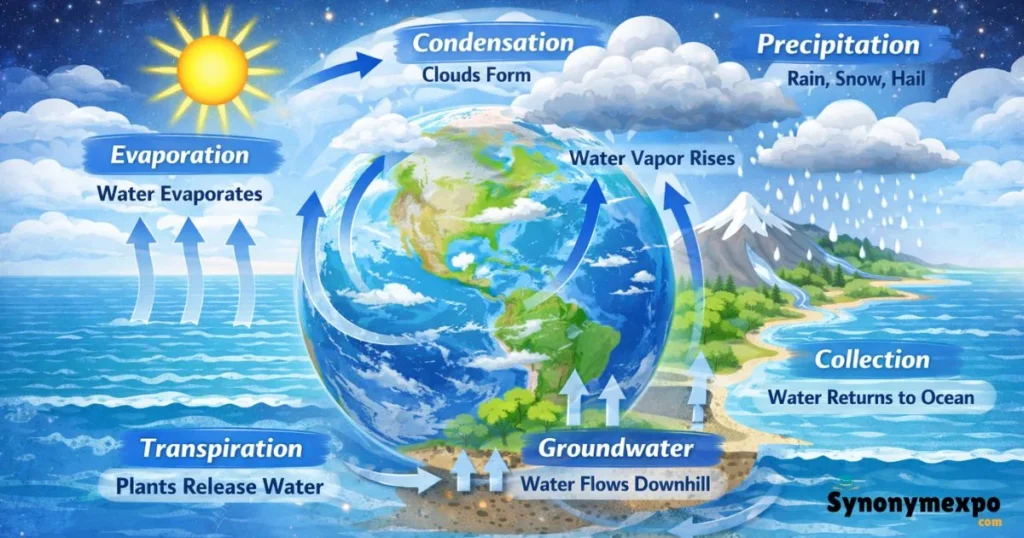
Meaning: The impact of the water cycle on climate and weather systems.
Explanation: Connects hydrological processes to temperature, rainfall, and storms.
Use When: Discussing climate science or meteorology.
Examples:
- The climate water cycle influences drought patterns worldwide.
- Researchers study the climate water cycle to predict seasonal storms.
16. Rain Cycle
Meaning: The recurring pattern of rain formation and fall.
Explanation: A simplified term for precipitation in everyday language.
Use When: Talking casually about weather or gardening.
Examples:
- The rain cycle ensures gardens and crops receive sufficient water.
- Understanding the rain cycle helps plan outdoor events.
17. Water Transfer Cycle
Meaning: The movement of water between rivers, lakes, soil, and atmosphere.
Explanation: Focuses on how water moves through different reservoirs.
Use When: Explaining ecosystems, agriculture, or environmental engineering.
Examples:
- The water transfer cycle is essential for sustaining wetlands.
- Engineers study the water transfer cycle to design irrigation systems.
18. Hydrologic Loop
Meaning: A cyclical representation of water movement in nature.
Explanation: Highlights the closed nature of the water cycle.
Use When: Explaining science diagrams or educational materials.
Examples:
- Students diagram the hydrologic loop to understand evaporation and runoff.
- Teachers use the hydrologic loop to illustrate global water flow.
19. Evapotranspiration Cycle
Meaning: The combined process of water evaporation from soil and transpiration from plants.
Explanation: Focuses on plant-water interactions in the ecosystem.
Use When: Discussing agriculture, botany, or ecology.
Examples:
- Understanding the evapotranspiration cycle helps farmers manage irrigation.
- The evapotranspiration cycle contributes to local humidity levels.
20. Water Movement System
Meaning: The organized flow of water through natural and engineered pathways.
Explanation: Includes rivers, streams, irrigation channels, and aquifers.
Use When: Explaining urban water supply or hydrology projects.
Examples:
- Engineers monitor the water movement system to prevent floods.
- The water movement system supports agriculture and municipal water supply.
Read More: Synonyms for Table of Contents | 35 Alternatives & Examples
21. Precipitation-Condensation Cycle
Meaning: The repetitive process of water vapor forming clouds and falling as precipitation.
Explanation: Focuses on cloud formation and rainfall stages.
Use When: Teaching meteorology or climate studies.
Examples:
- The precipitation-condensation cycle explains why storms form.
- Weather models track the precipitation-condensation cycle to forecast rain.
22. Atmospheric Water Cycle
Meaning: The movement of water through the atmosphere, including clouds, rain, and vapor.
Explanation: Emphasizes airborne water processes.
Use When: Discussing climate, storms, or weather systems.
Examples:
- The atmospheric water cycle drives regional weather patterns.
- Scientists study the atmospheric water cycle to understand rainfall distribution.
23. Water Recycling System
Meaning: The process of water naturally returning to the environment.
Explanation: Highlights repeated use of water in nature.
Use When: Discussing sustainability, environmental conservation, or urban planning.
Examples:
- Rivers and lakes are part of a natural water recycling system.
- Implementing a water recycling system in cities reduces water scarcity.
24. Eco Water Cycle
Meaning: The role of water movement in ecosystems and natural habitats.
Explanation: Connects hydrological processes to plants, animals, and soil.
Use When: Teaching ecology or environmental science.
Examples:
- The eco water cycle sustains forests and wetlands.
- Protecting the eco water cycle preserves biodiversity.
25. Precipitation-Collection Cycle
Meaning: The process where precipitation gathers in rivers, lakes, or underground.
Explanation: Highlights water storage after rainfall.
Use When: Explaining water reservoirs or flood management.
Examples:
- The precipitation-collection cycle fills dams and aquifers.
- Urban planners monitor the precipitation-collection cycle to prevent overflow.
26. Oceanic Water Cycle
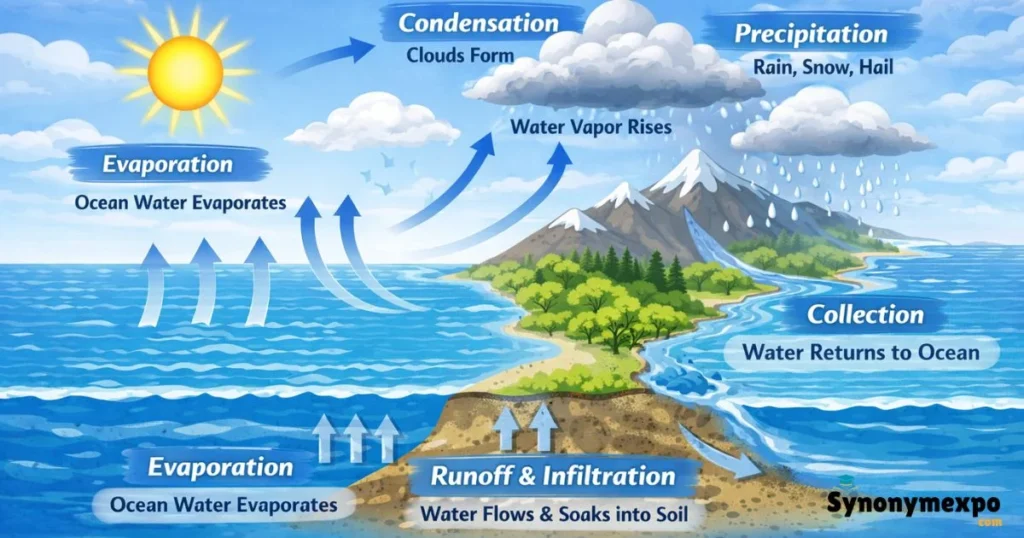
Meaning: The movement of water primarily involving oceans and large water bodies.
Explanation: Emphasizes evaporation and currents in marine environments.
Use When: Studying oceanography or global water distribution.
Examples:
- The oceanic water cycle affects global climate patterns.
- Marine scientists analyze the oceanic water cycle to predict currents.
27. Rainwater Cycle
Meaning: The process of rain forming, falling, and replenishing water sources.
Explanation: Focuses on rain as a part of the water cycle.
Use When: Talking about gardening, farming, or urban drainage.
Examples:
- The rainwater cycle is crucial for agriculture.
- Cities use the rainwater cycle to plan water harvesting systems.
Read More: Synonyms of Anthropology | 35 Best Alternatives & Examples
28. Soil-Water Cycle
Meaning: The movement of water through soil, including absorption, storage, and evaporation.
Explanation: Highlights groundwater recharge and plant hydration.
Use When: Discussing agriculture, gardening, or hydrology.
Examples:
- Understanding the soil-water cycle helps farmers manage irrigation efficiently.
- The soil-water cycle affects plant growth and soil health.
29. Evaporation-Flow Cycle
Meaning: The movement of water through evaporation and surface flow.
Explanation: Focuses on water changing from liquid to vapor and returning via rivers or lakes.
Use When: Explaining weather patterns or hydrology.
Examples:
- The evaporation-flow cycle drives cloud formation and rainfall.
- Monitoring the evaporation-flow cycle helps predict droughts.
30. Hydrosphere Cycle
Meaning: The movement of all water within the hydrosphere, including oceans, rivers, ice, and groundwater.
Explanation: Focuses on Earth’s water as a unified system.
Use When: Teaching earth science or global water management.
Examples:
- The hydrosphere cycle explains how water moves globally.
- Understanding the hydrosphere cycle is vital for climate modeling.
31. Aquifer Recharge Cycle
Meaning: The process of water seeping into aquifers to replenish groundwater.
Explanation: Highlights underground water storage in the water cycle.
Use When: Discussing groundwater management or sustainable water use.
Examples:
- The aquifer recharge cycle is essential for drinking water supply.
- Overuse of groundwater disrupts the aquifer recharge cycle.
Read More: Synonyms of Look | 35 Best Alternatives & Usage Examples
32. Surface Water Cycle
Meaning: The movement of water above the ground, including rivers, lakes, and streams.
Explanation: Focuses on observable water flow in nature.
Use When: Studying geography, hydrology, or urban planning.
Examples:
- The surface water cycle determines river levels.
- Floods occur when the surface water cycle is disrupted by heavy rain.
33. Rainfall-Runoff Cycle
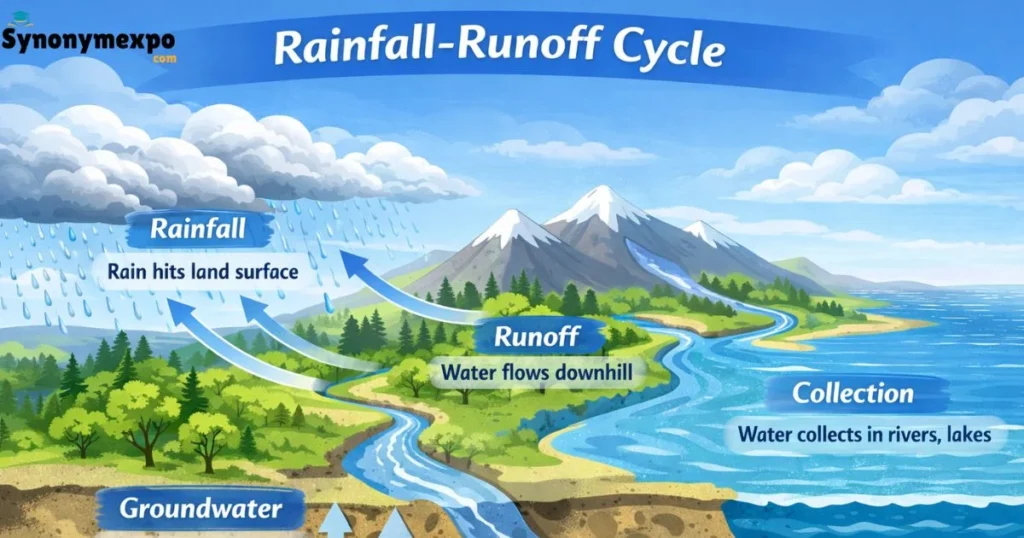
Meaning: The process of rainwater flowing into rivers, lakes, and oceans.
Explanation: Highlights surface runoff as part of water movement.
Use When: Explaining flood management or watershed studies.
Examples:
- Engineers analyze the rainfall-runoff cycle to prevent urban flooding.
- Changes in the rainfall-runoff cycle impact river ecosystems.
34. Water Renewal Cycle
Meaning: The continuous replacement of water in natural reservoirs.
Explanation: Emphasizes sustainability and natural replenishment.
Use When: Discussing conservation, ecosystem balance, or resource management.
Examples:
- The water renewal cycle ensures freshwater availability.
- Protecting forests helps maintain the water renewal cycle.
35. Global Water Cycle
Meaning: The movement of water around the entire planet, connecting oceans, atmosphere, and land.
Explanation: Highlights Earth-scale water distribution and climate influence.
Use When: Teaching earth science, climate studies, or environmental awareness.
Examples:
- The global water cycle regulates weather patterns worldwide.
- Understanding the global water cycle is essential for sustainable water management.
Water Cycle Antonym & Synonym List
| Synonyms | Synonyms | Antonyms | Antonyms |
|---|---|---|---|
| Hydrologic cycle | H₂O cycle | Water stagnation | Drought |
| Rain cycle | Precipitation cycle | Water isolation | Dry cycle |
| Evaporation-condensation cycle | Water circulation | No water movement | Dehydration process |
| Moisture cycle | Natural water cycle | Non-circulation of water | Aridity |
| Water renewal process | Atmospheric water cycle | Water scarcity | Desiccation |
| H₂O circulation | Global water cycle | Static water | Lack of precipitation |
| Water movement system | Precipitation-evaporation loop | Still water | Water depletion |
| Climate water loop | Rainfall-evaporation cycle | Water interruption | Water shortage |
| Hydrological loop | Water transport cycle | Stagnant reservoir | Drought conditions |
| Condensation-precipitation process | Evaporation-collection cycle | Blocked water flow | Dry environment |
How to Choose the Right Synonym for Synonyms of Water Cycle
Selecting the proper synonym depends on context, audience, and purpose. While all refer to the same natural process, nuances differentiate them:
| Synonym | Best Use Case | Tone / Context |
| Water cycle | General education, textbooks, popular science | Neutral, accessible |
| Hydrological cycle | Scientific research, hydrology, engineering | Formal, precise |
| Water circulation | Applied sciences, river systems, ecology | Practical, process-focused |
| Aquatic cycle | Environmental studies, ecological texts | Specialized, technical |
For Example: A climate change report may prefer “hydrological cycle” for technical accuracy, whereas a middle school science class benefits from “water cycle” for simplicity. Understanding semantic differences and audience familiarity ensures communication is clear, credible, and emotionally resonant.
Cultural and Emotional Nuance of Synonyms of Water Cycle
Synonyms of the water cycle carry different connotations across cultures and disciplines. In Western education, “water cycle” is often associated with learning and childhood science, evoking curiosity and wonder. In professional circles, “hydrological cycle” signals rigor and precision, often eliciting respect and trust.
Cultural perception also affects communication. Indigenous communities may describe water movement using metaphors linked to life, agriculture, or spirituality, emphasizing emotional and ecological connections. Similarly, in environmental campaigns, terms like “water circulation” or “aquatic cycle” are used to highlight sustainability and conservation, eliciting responsibility and urgency. Recognizing these subtleties allows educators, writers, and communicators to adapt language for engagement, clarity, and emotional resonance, ensuring messages are both scientifically accurate and culturally sensitive.
How to Recognize This Manipulative/Relevant Behavior
While the water cycle and its synonyms are primarily scientific terms, understanding how language choice can be manipulative or persuasive is crucial, especially in media, education, and environmental advocacy.
Practical signs include:
- Overuse of technical synonyms to appear authoritative or obscure comprehension.
- Switching terms inconsistently, causing confusion or misinterpretation.
- Emotionally charged framing, e.g., “aquatic crisis” vs. neutral “water cycle.”
- Exaggeration of impact using terms like “hydrological catastrophe” in non-critical contexts.
- Selective omission of context, focusing on certain stages (evaporation, precipitation) to influence perception.
Example: A campaign might use “aquatic cycle disruption” instead of the neutral “water cycle changes” to evoke urgency or fear. Awareness of these patterns enables critical reading, scientific literacy, and effective communication, ensuring clarity without emotional manipulation.
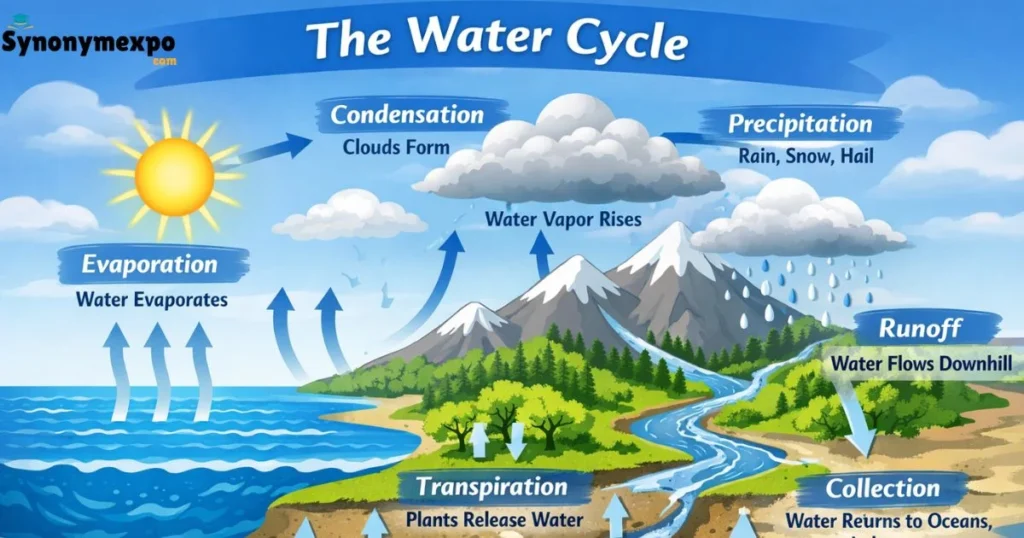
Water Cycle Diagram
Key Insight
1. What is another name for the water cycle?
The water cycle is also commonly called the hydrologic cycle or hydrological cycle. These terms describe the continuous movement of water through evaporation, condensation, precipitation, and runoff.
2. Why is understanding the water cycle important?
Understanding the water cycle is essential for environmental awareness, climate literacy, and effective communication. It helps people grasp rainfall patterns, flood risks, and water resource management.
3. What are the main stages of the water cycle?
The primary stages of the water cycle include evaporation, condensation, precipitation, runoff, and sometimes infiltration.
4. How do synonyms of the water cycle help in communication?
Using synonyms of the water cycle, like moisture cycle, aquatic movement, or Earth’s water cycle, improves clarity and precision.
5. Can the water cycle be affected by climate change?
Yes, the water cycle is directly influenced by climate change. Changes in temperature, evaporation rates, and rainfall patterns can alter the hydrologic process, global water distribution, and ecosystem balance.
Conclusion
Understanding the water cycle and its many synonyms, such as hydrologic cycle, water circulation, or Earth’s water cycle, gives you a clearer view of how water continuously moves through nature. Each alternative term emphasizes a slightly different aspect, from evapotranspiration in plants to oceanic water movement or groundwater recharge, making it easier to discuss, analyze, and teach water processes accurately. Recognizing these terms helps you communicate effectively in academic, professional, or everyday contexts, ensuring that discussions about rainfall patterns, floods, or sustainability are precise and meaningful.
By learning these 35 synonyms and understanding their context and usage, you can express ideas about water movement confidently, whether in climate studies, environmental science, or casual conversation. Being aware of variations like the moisture cycle, soil-water cycle, or global water cycle also enhances critical thinking, environmental awareness, and problem-solving skills. Ultimately, mastering these terms allows you to connect with nature, understand Earth’s systems, and convey your knowledge clearly, making discussions about the water cycle both informative and relatable.

Hi, I’M Jane Austen, the Admin of synonymexpo.com. I share the best word alternatives, synonyms, and language tips to help you write smarter and express ideas clearly.